


March 2026
Software
The startups in the United Arab Emirates in 2026 will work in a highly competitive and innovation-driven environment with a high rate of digital transformation, the influence of governmental technological programs, and the availability of the global market. Such businesses are supposed to grow rapidly, comply with changing regulatory systems and provide smooth digital experiences. Traditional monolithic software applications are often not able to address these needs as they are inflexible and expensive to maintain. As a result, the modular software architecture is being considered by a lot of startups in Dubai, Abu Dhabi, and other innovation centers.
Modular architecture provides an efficient, scalable and inexpensive base that follows the growth trends of the startups today. The division of applications into autonomous modules allows startups to have more control over the development of their usage, performance, and future enhancements. Such a strategy comes in handy especially in rapidly expanding industries like fintech, e-commerce, logistics, and health tech where flexibility and speed are most essential in decision making.
Modular software architecture is a design concept that breaks down an application into discrete and self-contained units each charged with a given business responsibility. These modules and communicate through clearly defined interfaces, thus they work on their own but as part of a bigger system.
As an example, a startup in the United Arab Emirates can divide the system into authentication, payments, analytics, customer support, and reporting modules. Each of the modules can be created, tested, deployed and updated independently and thus it does not impact on the rest of the system negatively. This is much better than monolithic architectures where even the slightest change can require a complete redeployment of the entire system.
In educational perspective, modular architecture encourages better code organization, cleaner system design and encourages team work in the development teams. It also supports modern development trends including microservice, cloud-native deployment, and API-based integrations that are mainly accepted members of the digital ecosystem of the United Arab Emirates.
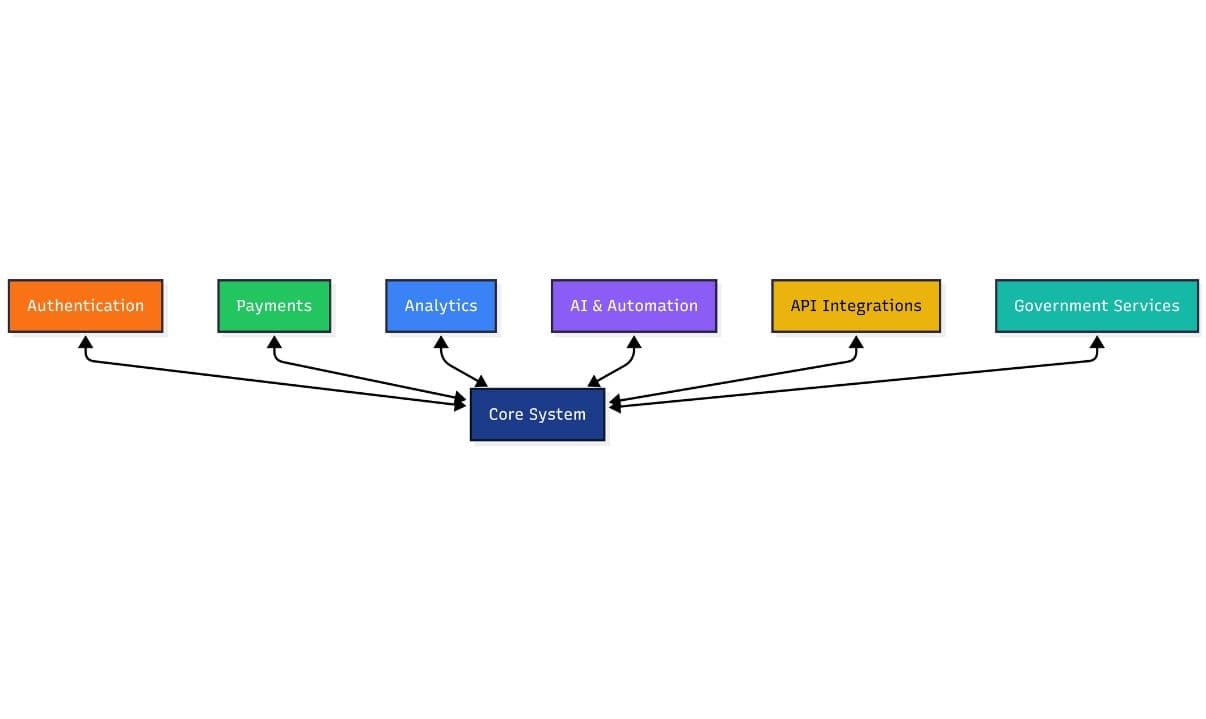
The ability to scale quickly (Rapid Scaling) is one of the main reasons as to why modular architecture is preferred by the startups of the United Arab Emirates, located in 2026. The startup is usually initiated through a minimum viable product (MVP) and then expanded later on as the demand rises. These stages are made much more efficient through the use of modular systems.
Instead of having to completely redesign the platform, the startups may just add new modules when entering new markets or creating new services. Indicatively, an e-commerce startup based in Dubai may implement a new logistics or international payment block without the interference of the current processes.
This scalability is particularly useful in the UAE, where startups often grow regionally in GCC or globally in a relatively brief period of time. Modular architecture means that growth does not affect the performance of the system negatively so that startups can scale without fear of losing stability and reliability.
Cost management is a very sensitive issue to startups and especially at the start up stage of funding. Modular architecture helps the startups located in the United Arab Emirates in managing development costs and operational costs because it enables phased investment in technology.
Startups can afford not to have non-essential features in the system because they can focus on the components they need and postpone the addition of the features that are not critical. The practice has allowed founders to match software spending with business milestones and subsequent funding round. New modules can be added or integrated, without having to significantly rewrite, as the revenue grows.
This method also reduces technical debt of an academic standpoint. Every module can be optimized separately thus avoiding the compounding of inefficiencies that big monolithic systems are known to bring. In the long run, this leads to lower maintenance expenses, improved performance and greater returns on technology investment.
Software maintenance is often undermined, but it is a key to success in the long run. The modular architecture also makes maintenance extremely easy since the changes made to particular modules are isolated. The developers would only have to focus on the part of the system that has been affected in case a bug appears or needs improvement and still maintain a stable system as a whole.
In the case of UAE startups that use 24/7 digital platforms, it means less downtime and a better user experience. Updates can be implemented faster, security patches can be implemented with increased efficiency and new features can be tested separately before implementation.
Another way that modular systems make continuous integration and continuous deployment (CI/CD) practices possible is educationally. Through such practices, the startups can also issue updates more often and maintain high software quality, a key requirement in competitive markets in the UAE.
It is anticipated that by 2026, the United Arab Emirates startups are more reliant on artificial intelligence, automation, cloud services and external application programming interfaces to enhance their services. The integration of these technologies is significantly easy with modular architecture. Every integration can also be a stand-alone module, which reduces the complexity and reduces risk.
As an example, an AI-powered analytics feature can be integrated into a startup or connected to government-owned digital solutions without the need to redesign its internal system. This flexibility is especially important in the United Arab Emirates when businesses often need to connect with regulatory, payment and logistics systems.
Educational perspective Modular architecture promotes interoperability and promotes innovation. Startups are able to test new tools and technologies and test them individually and scale the successful ones without disrupting the current work processes.
The technological development moves at a very fast pace and the start up needs to be able to embrace change. The concept of modular architecture future-proofs Emirati startups because it allows them to change or upgrade separate things as technologies, regulations, or customer needs change.
To illustrate, when a new cloud platform or AI framework becomes a standard in the industry, it may be implemented by a startup with modifications to the relevant module instead of creating the whole system. This flexibility is crucial in the UAE context, which has an innovation-oriented economy, and staying on the forefront of new trends is a competitive need.
Modular systems also promote sustainable development in an educational perspective. They encourage long-term planning, evolving systems in a cleaner manner, and technological discontinuity resilience. As a result, startups will have the ability to be agile, competitive and be scalable to a long time.
Modular software architecture will help UAE startups to grow faster, reduce the risk of development, and respond to faster market and technological changes that are expected in 2026. Building systems as independent units allows startups to gain flexibility, exercise fiscal discipline and guarantee sustainability in the long term.
It appears to be a strategic requirement that modular software architecture has become a strategic imperative of the startups of the United Arab Emirates by 2026 beyond the technical preference. Its natural flexibility, scalability, cost-effectiveness as well as prospective design makes it very appropriate to the enterprises that face the challenges of rapid growth and online transformation. In turn, by adopting modular systems, the UAE startups will be able to achieve a sustainable success in a more dynamic and technology-sensitive marketplace.